
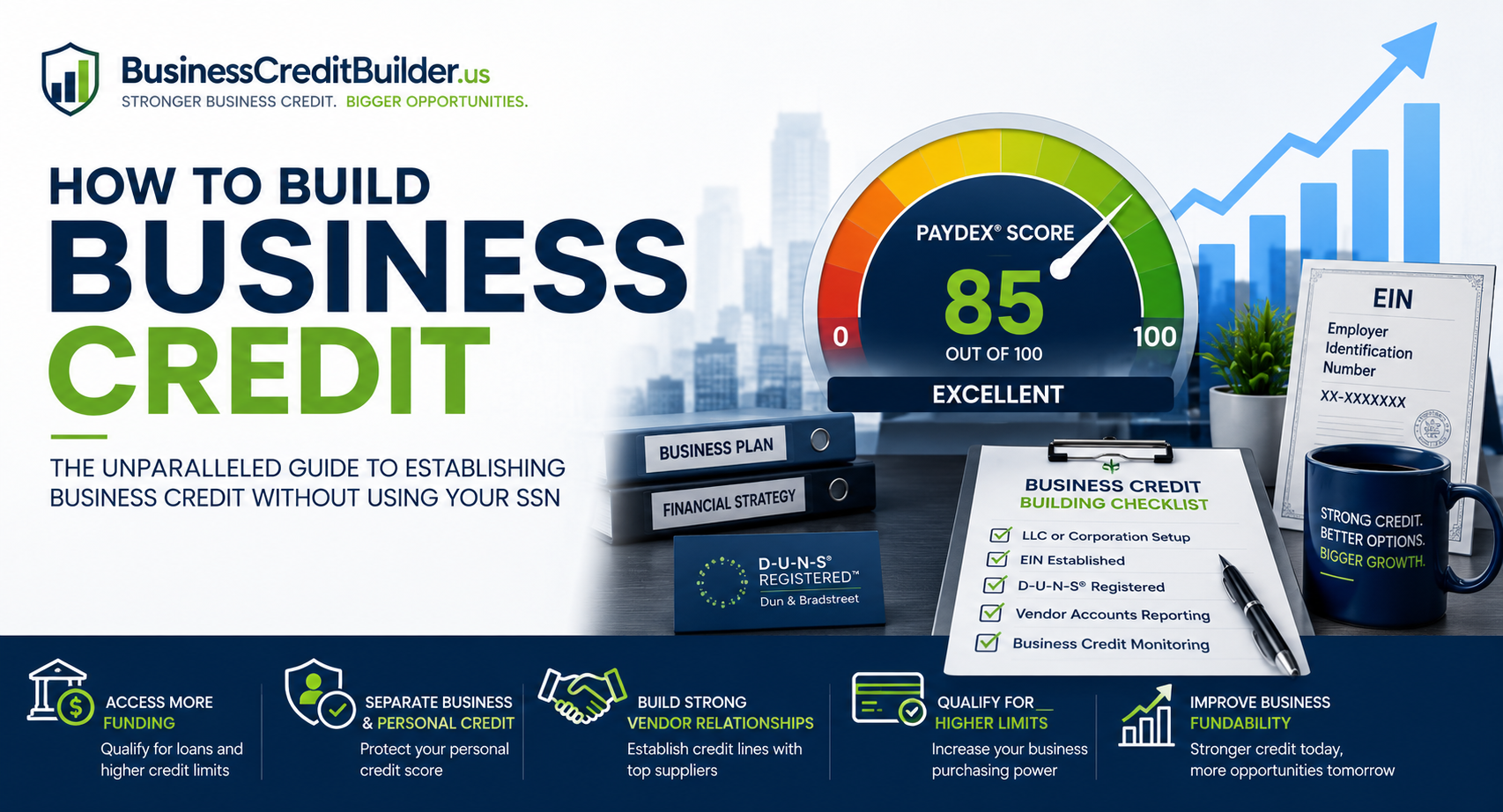
Build your business’s credit from scratch and unlock “EIN only” business financing with no personal guarantee.
We consulted the top business credit industry experts and (for the first time) revealed our unique business credit industry research.
This is the most cutting-edge business credit guide on the planet. We’ve seen people get top-notch business credit scores in less than 90 days following these steps – and unlock powerful financing for their business in record time!
1. Create a Separate Business Entity
Business credit issuers look for basic signs of legitimacy when assessing applications. If your credit history is limited, these fundamental indicators tend to have even more impact on your Fundability.
Our industry research discovered over 125 factors to consider! But here are some of the most critical ones to address.

Noel A. Booker Sr.
Business Credit Builder CEO
There are over 125 factors that we found that tie into your fundability. Set up your business to be structured so that you look credible. When you’re filling out an application for credit or financing, every line item on the application needs to make you look credible.
80% of financing applications are denied because your business details don’t match up, not because you don’t meet the lender’s qualifications.

There are over 125 factors that we found that tie into your fundability. Set up your business to be structured so that you look credible. When you’re filling out an application for credit or financing, every line item on the application needs to make you look credible.
80% of financing applications are denied because your business details don’t match up, not because you don’t meet the lender’s qualifications.
Business License
A business license proves your company is operating in compliance with local regulations.
Registering your business entity with your state can be similarly beneficial. Sole proprietors and partnerships have less financing options available to them. Some lenders only lend to entities like LLCs, S-Corps, and C-Corps.
Business Address
Stay away from P.O. boxes and UPS addresses. A genuine retail location or virtual office is ideal, but you can also use your home address as a last resort.
Business Phone Number
Avoid using a mobile phone or a home phone number for your business. Instead, consider using a VoIP service like Freedom Voice.
Phone Number Listed With 411
With your Freedom Voice account, your local phone business phone number should add the number to 411 directories for you. Other ways to list, you can use services like List Yourself or Local Listings to initiate the process.
Business Website
In 2025, a functional business website is all but required to anchor your digital presence. It doesn’t have to be fancy. But it should be professional, branded, and contain your business’s contact information.
Business Email Address
Instead of a generic Gmail, AOL, or Yahoo account, use an email address that ends in your website’s domain name. For example, if your website were SampleBusiness.com, your email address should look like email@samplebusiness.com. See our Small Business Web Hosting Plan.
2. Get an EIN
An Employer Identification Number (EIN) is like a Social Security number (SSN) for your business. You can use it to apply for credit with your company’s identity, helping you establish its credit history—and potentially protecting your personal credit score.
If you operate as a limited liability company or corporation, you should get an EIN before you form your legal entity. You can request one for free using the Internal Revenue Service’s (IRS) online portal.
It should only take a few minutes to complete the process, after which you should receive your EIN instantly if approved.
3. Get a DUNS Number
A DUNS number is a unique nine-digit number that identifies your business in the Dun & Bradstreet (D&B) database. D&B is one of the three major business credit bureaus, alongside Equifax Business and Experian Business.
Getting a DUNS number helps kickstart the opening of your D&B business credit report. In addition, lenders and vendors will often ask for one when you apply for credit.
You can apply for a DUNS number for free through D&B’s online portal. However, you may have to wait up to 30 business days to receive your number. If you pay for expedited service, you can get it within eight days.
4. Open a Business Bank Account
A separate bank account is another sign that your company is legitimate. we see that lenders may check whether yours is in good standing as part of their due diligence. Certain business credit scores ding you for not having one.
Even when that isn’t the case, simply having a business bank account is a common qualification requirement, especially with alternative credit providers. They often use bank account activity to help inform their underwriting.
A separate bank account is also invaluable for bookkeeping, making it easy to distinguish between personal and business expenses.
If you have trouble qualifying, consider using SIC codes that banks like. You can also pursue a second chance business checking account, which should have less rigorous requirements.
5. Open Vendor Tradelines
Also known as trade credit, vendor tradelines are credit accounts from merchants you do business with rather than lenders. They’re usually easier to get, especially as a new small business owner. In our experience, getting vendor tradelines is the most time-consuming part of building business credit.
They often have limited use cases outside of building credit. Many of the most popular vendor tradelines are net 30 accounts with supply companies, like Uline or Grainger Industrial Supply.
Opening vendor tradelines is the first real step toward creditworthiness, as they form the basis of your business credit history. Your business credit report primarily details how many you have, how long they’ve been open, and how you’ve used them.
The best vendors to build business credit share their data with each major business credit reporting agency, helping you get a strong credit score with each one.
6. Open a Business Credit Card
While not required, business credit cards can be powerful tools for building strong business credit. They’re financial tradelines—like a business loan or other traditional credit line—so they tend to be more impactful to your business credit profile than vendor tradelines.
They also tend to be more broadly usable, offer more flexible payment terms, and have a higher credit limit, making them useful for managing cash flow.
If you have a strong personal credit history, you can often qualify for a business credit card without a good business credit score. However, that usually means signing a personal guarantee, which makes you personally liable for the credit account.
Once your business credit is better established, you can apply for EIN only business credit cards that don’t require a personal guarantee.
7. Make On-Time or Early Payments
Unlike the personal credit market, where FICO dominates, no single scoring model defines business credit. As a result, business credit scores tend to differ more widely than personal credit scores in multiple ways.
For example, D&B’s PAYDEX Score ranges from 1 to 100 and is skewed highly towards your average payment timeliness. For a perfect rating, you must consistently make payments 30 days before they’re due. Simply paying on time caps your score at 80.
Meanwhile, the FICO Small Business Scoring Service (SBSS) score ranges from 0 to 300. It also uses a more comprehensive set of factors, including credit utilization, to estimate how likely your business is to make timely payments.
Despite these differences, payment history remains the most impactful factor across nearly all business scoring models. How long you’ve been paying and the timeliness of your payments heavily influence your scores.
As a result, building business credit is primarily about opening multiple tradelines and making your payments on time—or early, to maximize your PAYDEX—until you have a well-established business credit history.
8. Monitor Business Credit Reports and Scores
Building business credit is an ongoing process, not something you can set and forget. Even if your tradelines are open and your payments are automated, active engagement is necessary to keep things on track.
Business credit monitoring services are the best way to stay informed. In addition to providing regular access to your credit data, they should alert you whenever notable changes to your profile occur.
Common monitoring alerts might include:
- Drops in your score
- Late monthly payments
- New hard inquiries
These services can help you catch issues early, fine-tune your credit-building strategy, and stay motivated. Just be sure to pick one that monitors each major business credit bureau, as they may receive or report different information.
Want help with the credit-building process? Business Credit Builder’s business credit builder program provides step-by-step guidance, expert support, and powerful tools to fast-track your journey to a good credit score.
Noel A. Booker Sr.
BusinessCreditBuilder.us
404-500-9687
noel@businesscreditbuilder.us
MEDIA KIT